 Wizard Weekly by Daniel Giamario | May 10, 2026 |
On the heels of the recent intense Aries configurations and Uranus’ entry into Gemini, last Wednesday’s Pluto station retrograde is now stimulating intense focus on Pluto. The Moon’s alignment with Pluto on Friday also got my notice.
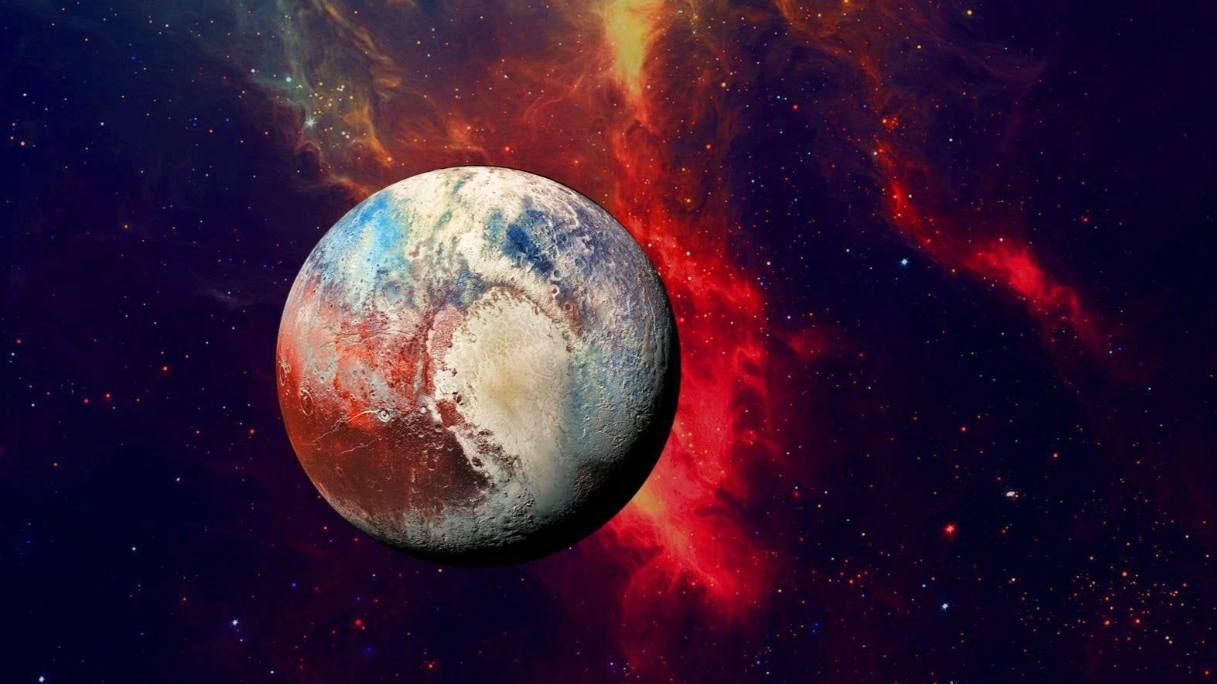 The other thing that happened last week is that various media outlets reported about reconsidering the demotion of Pluto to a “dwarf planet.” The story appeared on the EarthSky blog, in Sky&Telescope, on Forbes, the BBC, Scientific American and many more. Here is a link to the article in Nature.
As those of you who follow TOTAMS and myself know, I have never taken anything decreed by the International Astronomical Union (IAU) seriously. This of course applies to Pluto’s demotion to a “dwarf Planet” in 2006. In our astrology practice, there is nothing “dwarf” about Pluto.
Thus, it is high time to thoroughly consider and re-consider Pluto!
Words Have Meanings
Consider
I have always loved etymology. I also love the word “consider.”. And would you believe it – the word is highly relevant to our craft! Here is something that you can find when researching etymology online:
late 14c., consideren, “to fix the mind upon for careful examination, meditate upon,” also “view attentively, scrutinize; not to be negligent of,” from Old French considerer (13c.) “reflect on, consider, study,” from Latin considerare “to look at closely, observe,” probably literally “to observe the stars,” from assimilated form of com “with, together” (see con-) + sidus (genitive sideris) “heavenly body, star, constellation” (see sidereal).
So “to consider”, in its original sense, literally means to reach a decision by aligning with the stars. It seems that this meaning is all but forgotten now.
Pluto
We find equally interesting things when considering the word “Pluto.” Among the Romans, it has the additional spellings of “Pluton” and “Plouton”. Here is some more etymology:
Roman god of the underworld, early 14c., from Latin Pluto, Pluton, from Greek Ploutōn “god of wealth,” from ploutos “wealth, riches,” probably originally “overflowing,” from PIE root *pleu- “to flow.” The alternative Greek name or epithet of Hades is his function as the god of wealth (precious metals and gems, coming from beneath the earth, form part of his realm)
The well known words “plutocrat” and “plutocracy” are sort of related:
The meaning of Plutocrat is a person with power or influence due to his wealth: a member of a plutocracy.
Plutocracy is a government controlled exclusively by wealthy individuals, either directly or indirectly.
Plutocracy is a government where only the wealthy have control.
Wealth can influence policies, favoring the affluent.
Wealth
I believe that the original meaning of “wealth” has been hijacked and inverted, as always happens at the end of a Kali Yuga and at a Great Turning of The Ages. So what is “wealth” then? Check this out:
mid-12c., welth, “state or condition of happiness, well-being, joy” (contrasted with care or woe, a sense now obsolete), also “valuable material possessions; prosperity in abundance,” from wele “well-being” (see weal (n.1)) on analogy of health (see -th (2)).
No mention of money per se!
Knowing all this, how can we reconsider Pluto?
Revisioning The Classical Meaning of Pluto
 TOTAMS is engaged in the ambitious and sorely needed project of radically reconsidering and revisioning the classical meanings of the signs and planets. This is much needed with Pluto. When the patriarchal Zeus cults took over the ancient world, the Three Worlds were allocated to the three brothers:
- Zeus (Roman Jupiter) getting the sky and leadership
- Poseidon (Roman Neptune) being allocated the oceans
- and Hades (Roman Pluto) the Underworld.
- All three equally were allotted the Earth.
Wealth, however, came from below, the power and strength of the chthonic realm, the word meaning soil. It was the realm of the dead, but also of fecundity. The power and strength of the powerful currents below the surface of the ocean, and of the energy flows from the center of the Earth up, like the Kundalini. I had always loved the way Liz Green described Pluto as both dark-damp soil as well as running sewers. Yes, below ground are found rare gems and metals, but they are meant for true wealth, happiness and well-being, not to own and dominate. The latter is the Plutonian shadow. It’s so ironic that the Mafia and their government and corporate allies can also be considered the “underworld.”
Archetypal Feminine
It can be speculated that the Greeks and Romans (with similar equivalents in other cultures) actually saw these energetic patterns and called them “gods” and “goddesses.” In our vastly objectified and intellect ruled times, these are now known as the psychological archetypes. It is our contention that these archetypal energies are not fixed in concrete. They change and evolve depending on the Yugas and the precessional cycles. Why should the astrologers of today rely on classical patriarchal meanings that may have been true thousands of years ago, but are now less relevant?
Though TOTAMS can see archetypal Feminine and Masculine in all signs and planets, some lean more into one than the other. You can learn more about this by visiting our YouTube playlist Sex, Gender and Intimacy.
Personally, I have never thought or felt that Pluto was that Greek or Roman God. Rather, I sense Pluto (as well as Neptune) to be a strong archetypal Feminine essence. But in Pluto’s case, it is certainly not a sky or mother nurturer goddess. The essence here is that of a dark underworld Feminine. Sometimes she has been called the “teeth mother.” I would list Kali, Durga, Hecate, and surely Ereshkigal.
Pluto’s Contribution at The Great Turning
It is beyond the scope of these contemplations to delve into all the ways of navigating a Plutonian initiation, be it by transit or by natal complex. But I will offer a general approach to recognize Pluto’s contribution to those of us living through the Great Turning now.
There is no doubt that how Pluto works is by way of chaos, confusion, and irrational events that cannot be figured out by the mind. She offers conditions for surrender, for which there is no ‘technique” to find relief. Often, any attempt to understand (or overstand) this kind of experience ends here, and what remains is merely the hope that it may end at some point. What is often forgotten though, is what happens, if all goes well, following on from the surrender. The outcome is empowerment and true wealth – the power and strength from below the Earth.
 Plutonian initiations are a natural and organic part of the Life Process on Planet Earth. We all encounter them, some people more than others. When placed in the larger context of a Great Turning and the beginning of a post-KaliYuga epoch, the deepest descent of Spirit into Matter has occurred, and the recognition of the deceptive inversions and composting of materialism is sure to take place. All Plutonian initiatory processes include deathing and birthing, surrender and empowerment. Out of compost comes new life, renewal, and rebirth.
Calling In The 12 Tribes
Join TOTAMS as we are initiating our Calling In The 12 Tribes project to radically revision the 12 Mystery Schools of Life aka signs.
Click here to get the intro session free or by donation.
****************************
TOTAMS strives to continuously bring you high quality articles, courses and in-person events, reflecting the latest developments in the unique Shamanic Astrology Paradigm ™. If you enjoy this content, consider leaving a tip!